
There is a question that every structural engineer dreads hearing after a building has already been constructed.
"Why is the steel visible on the surface of this column?"
It is a question that signals something went wrong long before the concrete was poured. Long before the walls went up. Long before anyone thought about finishing or painting or handover.
It signals that somewhere during the reinforcement placement stage, a small but critical component was either missing, incorrectly sized, or completely ignored.
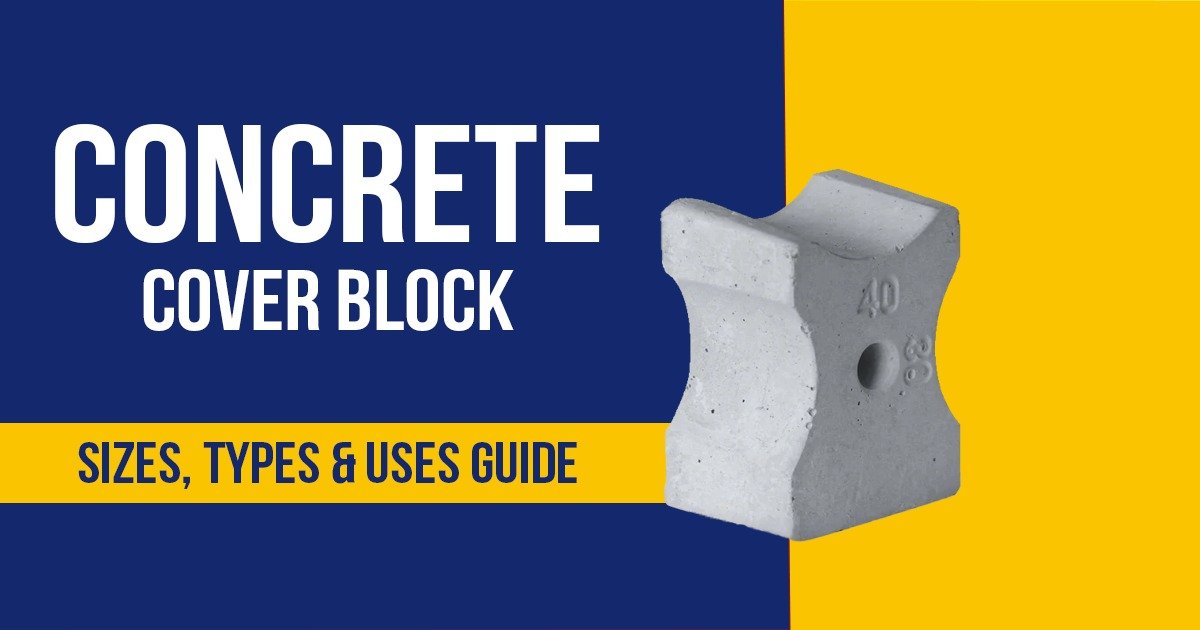
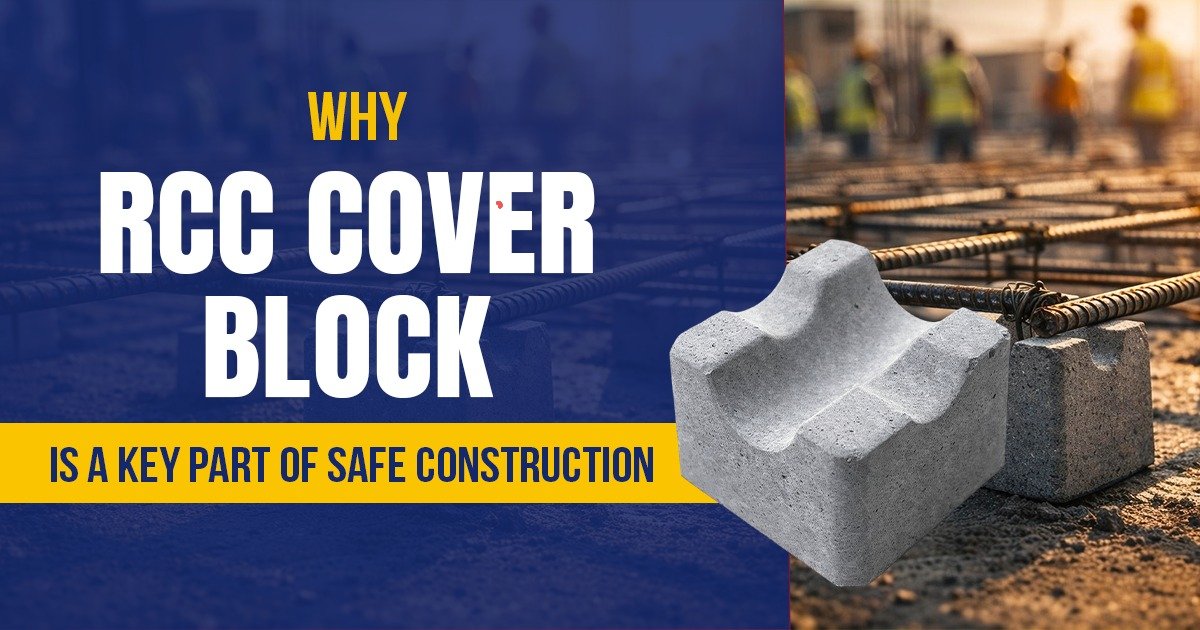
That component is the RCC cover block. And its role in safe construction is far greater than its physical size would suggest.
Start Here: Understanding What "Safe Construction" Actually Means
When we say a building is safe, most people picture things like strong walls, quality cement, proper foundation depth, and earthquake-resistant design.
All of those matter enormously. But structural safety also comes from invisible decisions, the ones made inside the concrete, before it hardens, that determine whether the steel reinforcement performs as designed for the next 50 to 100 years.
One of those decisions is how much concrete cover surrounds the reinforcement bars.
Too little cover, and moisture reaches the steel. Corrosion begins. Steel expands as it rusts. Concrete cracks and spalls from the inside. Load-carrying capacity drops. The structure that looked perfectly fine at completion begins to compromise occupant safety years later.
The RCC cover block is the construction material that prevents this chain of events before it ever starts. It is not decorative. It is not supplementary. It is a structural safety requirement.
How a 40mm Block Carries the Weight of Decades
Here is something worth sitting with for a moment.
A typical RCC cover block for a column in moderate exposure conditions is 40mm thick. That is roughly the width of your thumb. Yet that 40mm of concrete surrounding the outermost steel bar is the primary barrier between the reinforcement and the external environment.
For the structure to remain safe over its design life, that barrier must be:
- Continuous with no gaps or voids
- At the correct minimum thickness as per IS 456:2000
- Present on all sides of the reinforcement cage
- Maintained during and after the concrete pour
The cover block creates the starting condition for all four of these requirements. It lifts the reinforcement off the formwork or soil. It holds it at a fixed, measured distance. And because it is cast into the concrete, it becomes part of the permanent structure.
No improvisation. No estimation by eye. No hoping that workers maintained the right gap while pouring. Just a fixed dimension doing its job.
The IS 456 Connection: What the Code Actually Says
India's primary standard for reinforced concrete design, IS 456:2000, dedicates specific attention to clear cover requirements because the authors of that code understood something that construction sites sometimes forget: the concrete protecting the steel is not a passive material. It is an active safety system.
The code specifies minimum clear cover based on exposure conditions:
Mild exposure (protected indoor surfaces): 20mm minimum
Moderate exposure (sheltered outdoor, permanently submerged): 30mm minimum
Severe exposure (exposed to seawater spray, alternate wetting and drying): 45mm minimum
Very severe and extreme exposure (tidal zones, highly aggressive industrial environments): 50mm and above
These are not conservative suggestions built in for comfort. They are calculated minimums derived from carbonation rates, chloride diffusion studies, and decades of observed structural behaviour.
When a contractor installs an RCC cover block of the correct thickness, they are not just following a rule. They are implementing a scientifically established safety margin for the structure.
Practical Walk-Through: Cover Blocks Across Different Structural Elements
Let us get specific about how cover blocks function across the main elements of an RCC structure.
The Foundation: Where Safety Begins Underground
Most people do not think of footings and grade beams as elements requiring special attention. They are underground. Nobody sees them after the concrete is poured.
But footings are in continuous contact with soil, which means they are in continuous contact with whatever moisture, sulphates, and chlorides that soil contains.
IS 456 specifies 50mm clear cover for concrete cast directly against earth. This means the reinforcement cage in your footing must sit 50mm away from the soil or blinding concrete at the bottom and sides.
RCC cover blocks placed beneath and around the footing cage before the pour ensure this happens reliably. Without them, the cage rests on the blinding or is held manually by workers, which is neither precise nor consistent.
A footing that lacks proper cover may look identical to a properly covered one from the surface. But underground, the unprotected steel is already beginning its slow degradation.
Columns: The Most Visible Failures Start Here
Column failures are the ones that make it into newspaper reports and engineering post-mortems. They are also among the most preventable when basic cover requirements are respected.
Columns need cover on all four faces simultaneously. The reinforcement cage, made up of longitudinal bars bound by lateral ties, must be positioned exactly at the centre of the column cross-section.
When cover is insufficient on even one face of a column, that face becomes the weak point. Moisture enters. Steel corrodes. The concrete spalls. And a column that was designed to carry many tonnes of load begins to lose its effectiveness in a highly visible and often dangerous way.
RCC cover blocks for columns are typically chair-type or butterfly spacers that clip to the outermost bars and bear against the formwork. They hold the cage in position through the entire pour, including during vibration, which can cause significant movement.
Beams: Tension Steel Must Be Protected
The bottom of a beam carries tension. The steel reinforcement at the bottom face is doing the critical work of keeping the beam from cracking and failing under load.
That same bottom face is also the most exposed to environmental attack in covered buildings, because moisture, condensation, and temperature cycles all act on the underside of beams over time.
Cover blocks placed under the main tension bars in a beam ensure the bottom cover is maintained from end to end. This is not just about code compliance. It is about ensuring the element that is doing the hardest structural work is also the best protected.
Slabs: Large Area, Consistent Placement Needed
A typical residential floor slab might cover several hundred square metres. Reinforcement meshes are placed across this entire area. Without cover blocks, the mesh rests directly on the formwork.
When concrete is poured from above and vibrated, the mesh can shift. Workers walk on it. It deflects under their weight. In the absence of cover blocks, the reinforcement ends up embedded at inconsistent depths, with some points at the right cover and others at near zero.
Cover blocks distributed at regular intervals across the slab, typically every 600mm to 800mm, give the mesh a stable platform at exactly the right height. The result is consistent cover throughout the slab, not just at the points someone happened to check during the pour.
Three Cover Block Mistakes That Compromise Safety
Even builders who understand the importance of cover blocks sometimes make errors in practice. These three are the most common and the most consequential.
Using the wrong size for the element or exposure condition. A 20mm cover block used in a footing that requires 50mm provides almost no protection. Cover block selection must be driven by the structural drawings and the IS 456 specification for each element.
Spacing cover blocks too far apart. The cover block maintains cover only at the point where it is placed. If blocks are spaced one metre apart on a slab, the reinforcement mesh sags between those points and may touch the formwork. Correct spacing is critical.
Using improvised materials instead of manufactured cover blocks. Stones, broken bricks, pieces of tile, scrap wood: these are all found in use as improvised spacers on construction sites where cover blocks were not procured. None of these have defined dimensions. None of them are reliable. All of them represent a safety compromise that will be invisible after the pour but present in the structure for its entire life.
Why the Market Trusts Goyal Cement Blocking
There are many manufacturers of RCC cover blocks across India. The difference between them is not always visible until you are on site and it matters.
Goyal Cement Blocking has established a reputation among contractors, site engineers, and procurement managers for something that sounds simple but is surprisingly uncommon: consistency.
When a structural drawing specifies 40mm clear cover, the block purchased should measure exactly 40mm. Not 37mm. Not 43mm. Exactly 40mm. Because the IS code specified 40mm for a reason, and a cover block that deviates from that dimension defeats its own purpose.
Goyal's manufacturing process is built around this principle. Each standard size is produced with controlled mix design and precise moulds, so what is labelled is what is delivered.
Beyond dimensions, the blocks are produced with sufficient compressive strength to survive construction loads. A cover block that crumbles when a reinforcement cage is set on it provides zero protection. Goyal blocks maintain their integrity through the placement, pouring, and vibration process.
For contractors managing large projects where thousands of cover blocks are needed across multiple pours, reliable supply without shortages or substitutions is equally important. Goyal has the production capacity and logistics to support projects at scale without disruption.
It is the kind of supplier relationship that experienced contractors build quietly, because it removes one more variable from an already complex process.
The Conclusion That Should Be a Starting Point
Safe construction is not a single decision. It is hundreds of small decisions made correctly, consistently, across every stage of a project.
The RCC cover block represents one of those decisions. Small in size. Easy to install. Inexpensive relative to the overall project. But absent from that decision, and the structure you build today carries a hidden risk that surfaces years later, after occupation, after handover, after everyone has moved on.
Goyal Cement Blocking exists to make that decision simple. Accurate dimensions, dependable quality, and reliable availability across all standard sizes mean that your site teams have what they need to build correctly from the foundation up.
Because safe construction is not about what you can see after the work is done. It is about what you cannot see and whether you can trust that it was done right.
Frequently Asked Questions
Quick answers to what people usually ask.