
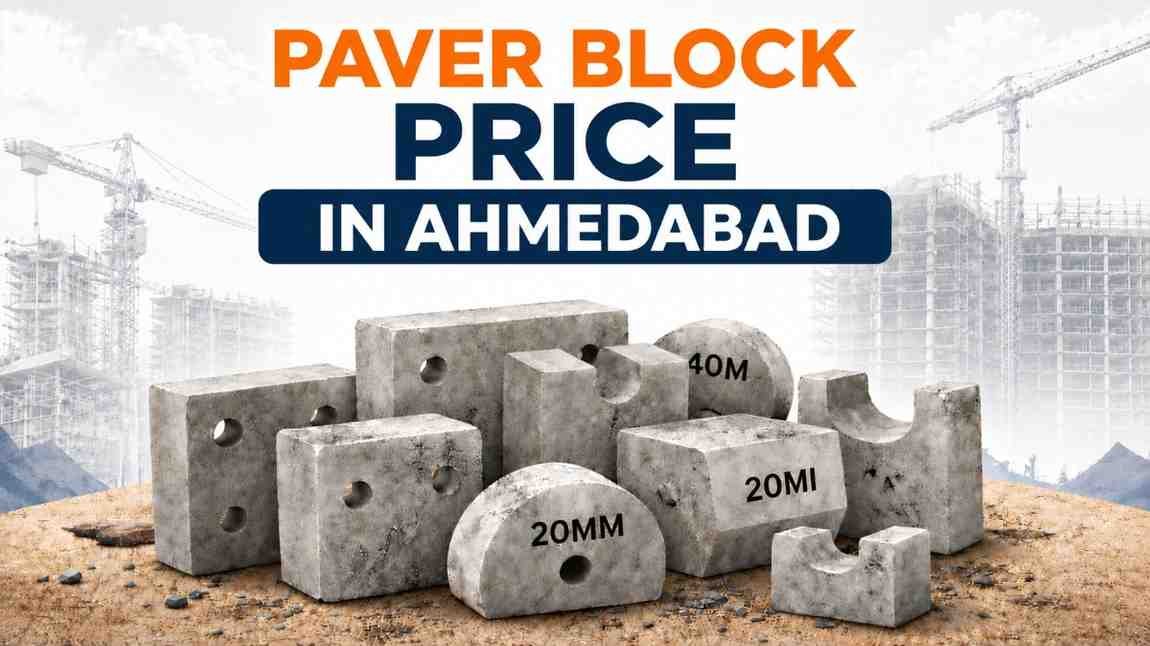
This guide walks you through everything that affects paver block pricing in Ahmedabad, what different block types actually cost to produce and why, and how to make a buying decision you won't regret six months into your project.
Why Paver Block Price in Ahmedabad Varies So Much
If you've already called a few suppliers, you've probably noticed the quotes don't match. Sometimes the difference is significant enough to feel suspicious. That gap is real, and it's not random.
Several factors drive price variation in the Ahmedabad market, and understanding them helps you compare quotes on equal footing rather than just chasing the lowest number.
Block Type and Specification
This is the largest single variable. A standard zig-zag paver block for pedestrian use has a different raw material profile and production requirement than an 80mm heavy-duty industrial block. Coloured designer pavers cost more to produce than plain grey ones. Comparing quotes without confirming you're comparing identical specifications is comparing apples to mangoes.
Raw Material Composition
Cement grade, aggregate quality, and admixture usage directly determine both block strength and production cost. Manufacturers using higher-grade OPC cement with well-graded aggregates and proper water-cement ratios produce stronger, more durable blocks. They also spend more on inputs. That difference shows up in the quote.
I've noticed that the cheapest quotes in the Ahmedabad market almost always involve compromises on raw material quality that aren't visible to the eye but show up within a few seasons of use.
Production Technology
Blocks produced using automated vibro-compaction presses are denser, dimensionally consistent, and structurally more reliable than manually or semi-manually produced alternatives. The capital investment in proper production machinery reflects in the unit cost. It also reflects in how long the surface actually lasts.
Order Volume
Bulk orders consistently attract better unit economics. A 500-piece order and a 10,000-piece order will carry different per-unit costs from the same manufacturer. If your project allows for it, consolidating your order volume is one of the most straightforward ways to improve your effective cost.
Delivery Distance and Logistics
Ahmedabad buyers sourcing from manufacturers in Haryana, Rajasthan, or other states need to factor transportation into the effective per-unit cost. A slightly higher ex-factory price from a manufacturer with efficient logistics to Gujarat may land cheaper on-site than a nominally lower price with expensive or unreliable freight.
Understanding Block Types and Their Cost Profiles
Getting specific about which block type your project needs is the necessary step before any price conversation makes sense.
60mm Paver Blocks
The standard thickness for pedestrian applications. Walkways, garden paths, residential courtyards, and low-traffic areas. These are the most commonly ordered blocks in residential projects across Ahmedabad and represent the baseline product most suppliers quote first.
80mm Paver Blocks
Required for driveways, parking areas, and any surface that will see regular vehicular traffic. The additional thickness significantly increases load-bearing capacity and surface longevity under vehicle weight. Using 60mm blocks in a driveway application is a common and costly mistake.
Zig-Zag Interlocking Blocks
The most popular format for high-traffic surfaces. The interlocking geometry creates lateral resistance that keeps the surface stable under load. Widely used in commercial parking lots, bus terminals, industrial compounds, and township roads across Gujarat.
Rectangular and Holland Pavers
Cleaner geometry, simpler installation. Popular in residential projects, pedestrian zones, and commercial spaces where a more formal visual pattern is preferred. Slightly easier to cut and fit at edges and corners.
Coloured and Designer Pavers
Pigmented blocks for applications where appearance matters alongside function. Hotels, retail complexes, premium residential projects, and public spaces. Quality coloured blocks use through-body pigmentation so the colour is consistent throughout the block, not just on the surface. Surface-pigmented alternatives look acceptable initially but show wear quickly.
Uni-Pavers and Road Pavers
Engineered specifically for road and mixed-traffic applications. These carry higher compressive strength specifications and are used extensively in municipal infrastructure, township road networks, and government projects.
What Genuinely Affects Long-Term Value
Price is what you pay once. Value is what you experience for the next twenty years. These two things are related but not the same.
A civil engineer I spoke with while reviewing a large paving project in Surat put it clearly: "The installed cost of a paver surface includes the blocks, the base preparation, the labour, and the maintenance over the surface's life. Saving five percent on block cost and then replacing the surface in four years instead of twenty is negative savings."
That framing is worth keeping in mind every time you're tempted to go with the cheapest quote without verifying what you're actually getting.
In my experience, the projects that hold up best in Gujarat's climate, with its cycle of intense summer heat and heavy monsoon rainfall, are the ones where compressive strength and water absorption specifications were taken seriously from the start. Blocks with high water absorption rates absorb monsoon moisture, expand slightly, and begin spalling at edges and surfaces faster than anyone expects.
IS 15658, the Indian standard governing paver blocks, specifies a maximum water absorption of 6% and minimum compressive strength of 30 N/mm² for standard pedestrian applications. These aren't bureaucratic checkboxes. They're the product of engineering experience about what actually fails in the field.
Comparing Quotes the Right Way
When you receive multiple quotes for paver blocks in Ahmedabad, here's how to compare them meaningfully rather than just ranking numbers from low to high.
First, confirm the block specifications are identical. Same dimensions, same thickness, same type. A quote for manually produced 60mm blocks is not comparable to a quote for machine-vibrated 60mm blocks even if the dimensions look the same on paper.
Second, confirm compressive strength. Ask each supplier what compressive strength their blocks achieve at 28 days. Document the answers. Any supplier unwilling or unable to answer this question is telling you something important about their quality controls.
Third, clarify what the quoted price includes. Ex-factory price, delivery to site, and any unloading arrangements can vary significantly between suppliers. Establish a delivered-to-site comparison before making a final decision.
Fourth, ask about payment terms and supply consistency. For larger projects, staged delivery tied to installation progress is often more practical than a single large delivery. Confirm the supplier can maintain supply throughout your project timeline.
The Ahmedabad Construction Context
Ahmedabad's construction activity level means there's real demand pressure on quality paving materials. Smart city development, expanding residential corridors in areas like Bopal, South Bopal, Shela, and Chandkheda, plus active industrial growth around Sanand and Bavla have all kept demand strong.
That demand has attracted a wide range of suppliers, from well-equipped manufacturers with proper quality systems to small-scale producers who are essentially making blocks in relatively informal setups. The price range reflects this diversity directly.
When I reviewed supplier options serving the Ahmedabad market, the most consistent feedback from contractors related to two things: dimensional accuracy and supply reliability. A supplier who delivers dimensionally accurate blocks on a consistent schedule is worth more to an active construction site than one who is marginally cheaper but inconsistent in both product quality and delivery timing.
Sourcing from Outside Ahmedabad: When It Makes Sense
For larger projects, looking beyond purely local suppliers is a practical and well-established approach among experienced Ahmedabad contractors. Manufacturers in Haryana, Rajasthan, and Madhya Pradesh regularly supply Gujarat, and the logistics infrastructure supporting this supply chain is well-developed.
Goyal Cement Blocking, based in Hodal, Haryana, is one manufacturer that supplies paver blocks consistently to clients across Ahmedabad and Gujarat. Their production is built around vibro-compaction technology with documented quality testing, and their logistics capability to serve Gujarat makes them a viable option for both mid-size and large bulk orders.
In my experience, sourcing from an established manufacturer with a strong quality track record, even if they're not locally based, often delivers better overall project value than defaulting to the nearest supplier. The blocks spend their lives on your project site, not on a truck, so where they were made matters less than how well they were made.
Practical Tips for Getting the Best Value on Paver Blocks in Ahmedabad
A few things that consistently help buyers in this market:
- Order samples before committing to bulk. Physical samples reveal surface quality, dimensional consistency, and weight uniformity that photographs cannot show.
- Request IS certification or third-party test reports. Reputable manufacturers maintain documentation. Vague answers to this request are a clear signal.
- Consolidate your order where possible. Volume commitments improve unit economics meaningfully.
- Plan delivery logistics early. For large orders, staggered deliveries timed to installation progress reduce on-site storage damage and material handling costs.
- Verify curing standards. Blocks need a minimum of 28 days proper curing to reach full compressive strength. Manufacturers cutting this timeline short are delivering weaker products.
- Confirm dimensional tolerances. Ask specifically about acceptable variation in length, width, and height across a batch. Tighter tolerances produce better-looking, better-performing surfaces.
Why Goyal Cement Blocking Is Worth Considering for Ahmedabad Projects
Among suppliers serving the Ahmedabad market, Goyal Cement Blocking consistently earns positive mention from contractors focused on project quality rather than just upfront cost. Their product range covers the standard paver block types needed for residential, commercial, and industrial applications, and their manufacturing process prioritises the specifications that actually determine long-term performance.
According to industry data from the Confederation of Real Estate Developers' Associations of India, construction material quality directly correlates with long-term maintenance costs in residential and commercial developments. Manufacturers who invest in automated production and quality documentation consistently reduce lifecycle costs for project owners. That principle aligns well with what Goyal Cement Blocking delivers in practice.
Getting the paver block price in Ahmedabad right is about more than finding the lowest number in a spreadsheet. It's about knowing what you're buying, verifying that the product meets the specifications your project actually needs, and choosing a supplier whose quality controls mean the surface you build today is still performing well a decade from now.