
Picture this.
A large infrastructure contractor wins a contract for a multi-storey housing complex under the Pradhan Mantri Awas Yojana scheme. Fifty buildings. Thousands of slabs, columns, beams, and footings. A tight deadline. A quality audit built into every stage of the project.
The project manager sits down to finalise the material procurement list. Cement, steel, aggregates, admixtures, shuttering, all the obvious things get locked in quickly. Then someone raises the question of cover blocks.
"How many do we need?"
The number that comes back stops the room briefly. Hundreds of thousands of units, across multiple cover sizes, to be delivered in phased batches aligned with construction progress.
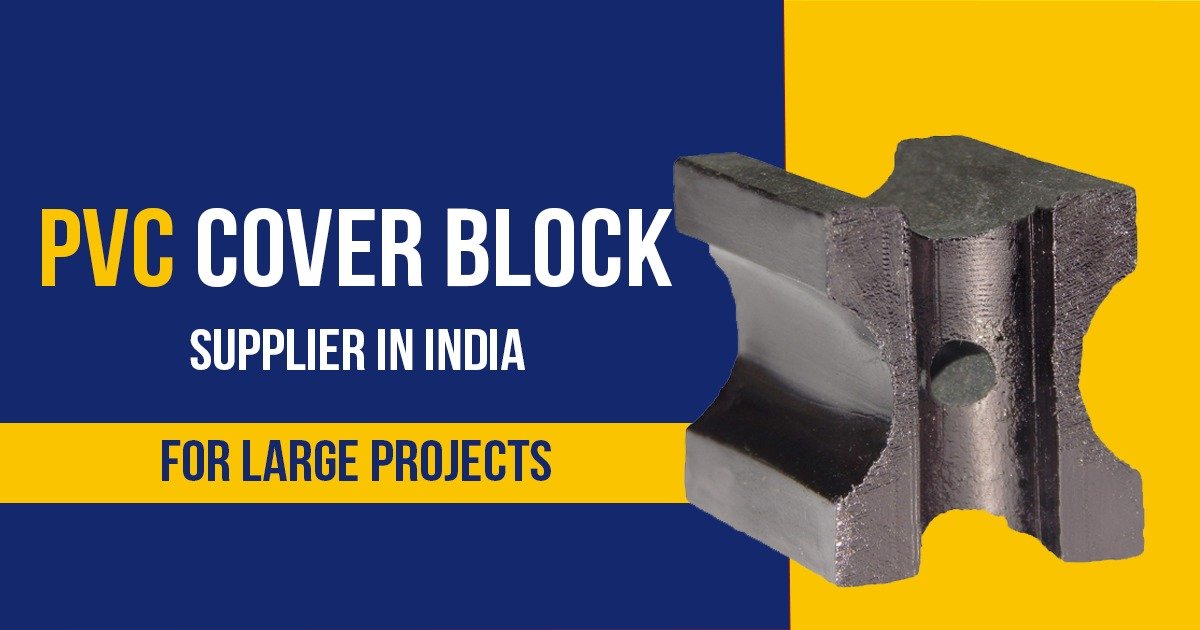
That is the moment when choosing the right PVC cover block supplier in India stops being a minor procurement decision and becomes a project-critical one.
This blog is written for everyone who has been in that room, or will be.
Why Large Projects Demand a Different Level of Supplier
On a small residential project, cover block procurement is relatively straightforward. You estimate the quantity, place a local order, and the blocks arrive. If there is a minor sizing inconsistency or a short supply on a given day, the supervisor finds a workaround.
Large projects do not have that flexibility.
When you are managing simultaneous pours across multiple buildings, quality control audits happening weekly, and third-party inspectors checking cover depths with cover meters, there is no room for workarounds. Every cover block on every slab, column, beam, and footing must be dimensionally accurate. Every batch must match the specification. And supply must arrive on time, every time, without shortages that halt construction progress.
This is the operating reality that separates a casual cover block purchase from a strategic supply partnership.
A reliable PVC cover block supplier in India for large projects is not just a vendor. They are a quality assurance partner, one whose product precision directly influences whether the project passes its structural quality checks.
What PVC Cover Blocks Bring to a Large Project Environment
Before exploring the supply and logistics side, it is worth understanding why PVC specifically has become the preferred material for cover blocks on quality-conscious large projects.
Traditional cement and concrete cover blocks have served Indian construction for decades. They still have a place. But on large projects where thousands of blocks are being placed by multiple teams across different elements simultaneously, PVC offers three practical advantages that cement blocks simply cannot match consistently.
Dimensional consistency at scale. PVC cover blocks are injection moulded. Every block from the same mould is identical in dimension. When you order 50,000 units of a 40mm PVC cover block, you get 50,000 units that each measure exactly 40mm. This is not guaranteed with cast cement blocks, where mix variation, curing conditions, and mould wear all introduce dimensional drift over large production runs.
Resistance to site handling. On a large project, cover blocks travel from storage to multiple work areas. They are handled by workers, transported in batches, and placed under reinforcement cages that may weigh considerably. PVC blocks withstand this handling without cracking or chipping. A cement cover block that arrives at a pour already cracked is a block that will not hold the required cover.
Zero water absorption. Cement cover blocks are porous. In wet conditions during storage or after placement before the pour, they absorb moisture. PVC blocks do not. This matters particularly for foundation elements and below-grade construction where the environment around the block is wet before the concrete even arrives.
For large project procurement managers, these are not theoretical advantages. They are practical differentiators that reduce rework, reduce quality failures, and simplify site management.
The Elements Where Cover Blocks Are Non-Negotiable on Large Projects
Large construction projects are complex ecosystems of interconnected structural elements. Here is how cover blocks function across the key ones, and why getting it right in each matters at project scale.
Foundation and Footing Work: The First Quality Test
On any large project, foundation work sets the quality tone. Inspection agencies know this. Third-party auditors often focus heavily on the foundation stage because errors here are the hardest to correct and the longest-lasting in consequence.
IS 456:2000 mandates 50mm clear cover for reinforcement in concrete cast against earth. For large project footings, this means every footing cage must be sitting on 50mm PVC cover blocks before the lean concrete or blinding layer receives the steel.
The sheer volume of footings on a large project, potentially hundreds or thousands across the site, makes this a procurement and logistics challenge. Blocks must be on site, sorted by size, and available at each footing location as the cage is lowered.
A supplier who delivers 50mm and 40mm blocks mixed together in unlabelled batches creates chaos on site. A supplier who delivers clearly sized, clearly packaged batches aligned with the construction schedule creates efficiency.
Column Work: Cage Positioning Across Hundreds of Elements
Multi-storey projects have columns on every floor. Hundreds of columns per building, dozens of buildings, multiple floors each. That is potentially tens of thousands of individual column cages requiring accurate cover on all four faces.
Chair-type PVC cover blocks that clip around the vertical bars and bear against the formwork are the standard choice for columns. They hold the cage in position through the pour and through the vibration process.
For large project procurement, this means ordering the right type of PVC cover block, not just the right size. Chair covers and flat spacers have different applications. Suppliers who understand this distinction and supply accordingly are the ones that large project managers return to repeatedly.
Slab Construction: Volume Demand Is Highest Here
If columns demand precision, slabs demand volume. A single large floor plate might require cover blocks placed every 600mm in both directions across thousands of square metres. Multiply that across multiple floors and multiple buildings, and slab cover block consumption on a large project can run into the hundreds of thousands of units.
Two things matter here: accuracy and availability. Every block must be the correct size for the specified cover. And there must be enough of them, on site, when the pour team is ready.
Running short of cover blocks during a slab pour is not a minor inconvenience. It means either delaying the pour, which has cost and scheduling implications, or proceeding with inadequate cover at some points, which has structural and quality implications. Neither outcome is acceptable on a project with quality performance guarantees.
Beam and Lintel Elements: The Often-Overlooked Element
Beams tend to receive less attention in cover block planning than slabs and columns. This is a mistake.
Beams carry significant tension in their bottom steel. That bottom steel needs clear cover maintained from end to end. On a large project with hundreds of beams, each of varying span and cross-section, cover block placement in beams represents a real quality control challenge.
PVC cover blocks for beams must sit under the tension steel without being displaced when stirrups are tied and the cage is shifted into position. Blocks with a stable base and sufficient compressive strength to handle the cage weight are essential.
The Supply Chain Problem That Sinks Large Project Quality
Here is a scenario that plays out more often than it should on large construction sites across India.
A project is moving well. Foundation work is complete. Column work is progressing. The first major floor slab pour is scheduled for a particular date.
Three days before the pour, the site manager checks stock. The 25mm cover blocks for the slab are running low. An order is placed with the regular supplier. The supplier confirms delivery, but on the day before the pour, the batch arrives short. Half the required quantity is missing.
The project manager now has three choices: delay the pour, place emergency orders from an alternative supplier whose product quality is unknown, or proceed with reduced cover block density and hope the quality audit does not catch it.
None of these is a good option. All of them could have been avoided with a supply partner who had the production capacity and logistics reliability to fulfil large orders on time without shortfalls.
This is the supply chain problem that experienced large project managers account for when selecting a PVC cover block supplier in India. They are not just buying a product. They are buying reliability.
What Goyal Cement Blocking Delivers at Project Scale
Goyal Cement Blocking has been built specifically to serve the needs of builders and contractors who cannot afford supply uncertainty or dimensional inconsistency.
The production operation behind Goyal is set up to handle the volume demands of large infrastructure and residential projects. This is not a small local manufacturer filling orders as capacity allows. It is a structured production and supply operation that treats large project requirements as the primary use case, not an edge case.
Several things set Goyal apart in the context of large project supply.
Consistent dimensional accuracy across large production runs. When you place a repeat order for a size you have already used on earlier pours, you get the same dimensions you received the first time. There is no drift, no batch-to-batch variation, no discovering that this month's 40mm blocks are actually 38mm.
Range of sizes to cover all structural elements. From 15mm for interior elements to 75mm for aggressive exposure foundations, the full spectrum of IS 456 specified cover requirements is available. This means a large project procurement manager can single-source all cover block requirements from Goyal rather than managing multiple suppliers for different element types.
Phased supply aligned with construction progress. Large projects do not need all their cover blocks on day one. They need the right quantity of the right size at the right time. Goyal's logistics capability supports phased delivery schedules that align with construction milestones, reducing on-site storage requirements and the risk of block damage from prolonged storage.
A track record among contractors who deliver quality. The contractors who return to Goyal are not doing so because of aggressive pricing. They are doing so because on project after project, the product performed, the supply was reliable, and there were no cover-block-related quality failures. In an industry where reputation matters enormously, that track record is the real product.
The Partnership That Makes Large Projects Perform
Large construction projects succeed or fail on the quality and reliability of every input, not just the big-ticket materials.
Choosing the right PVC cover block supplier in India is one of those decisions that experienced project managers get right from the start, because they have seen what happens when it goes wrong mid-project.
Goyal Cement Blocking is built for that trust. Accurate dimensions. Consistent quality across large production runs. A supply capability that matches the scale of what India's construction industry is building right now.
If you are planning a large residential, commercial, or infrastructure project and want to discuss cover block supply requirements, Goyal Cement Blocking is the conversation worth having before your first pour.
Because on a large project, there is no recovering from a cover block problem after the concrete has set.
Frequently Asked Questions
Quick answers to what people usually ask.