
Nobody talks about the roof slab until something goes wrong with it.
When it is performing correctly, it is just there, solid and silent, holding up the floor above or shielding the building from weather. But when it starts to show cracks, rust stains, or patches of spalling concrete, suddenly everyone is very interested in what happened during construction.
In the majority of such cases, the investigation leads back to one issue: the reinforcement steel was not sitting where it should have been when the concrete was poured.
And that is a placement problem. Specifically, a cover block for slab placement problem.
This blog is a practical guide to understanding why cover block placement in slabs matters so deeply, how to get it right, and what separates a durable slab from one that shows its age within a few years of completion.
The Slab Is Deceptively Simple to Get Wrong
Of all the structural elements in a building, slabs look the most straightforward to construct. You lay the reinforcement mesh, pour the concrete, finish the surface, and you are done.
That apparent simplicity is precisely why errors happen.
The reinforcement in a slab has a very specific job. The bottom steel carries tension. The top steel handles negative moments near supports. Both layers must be at precisely the right depth within the concrete section for the slab to perform as the structural engineer designed it.
If the bottom steel sags and sits 5mm from the formwork instead of 25mm, two things happen simultaneously. First, the effective structural depth of the slab decreases, reducing its load-carrying capacity. Second, the concrete cover over that steel drops to almost nothing, leaving it vulnerable to moisture, carbonation, and eventual corrosion.
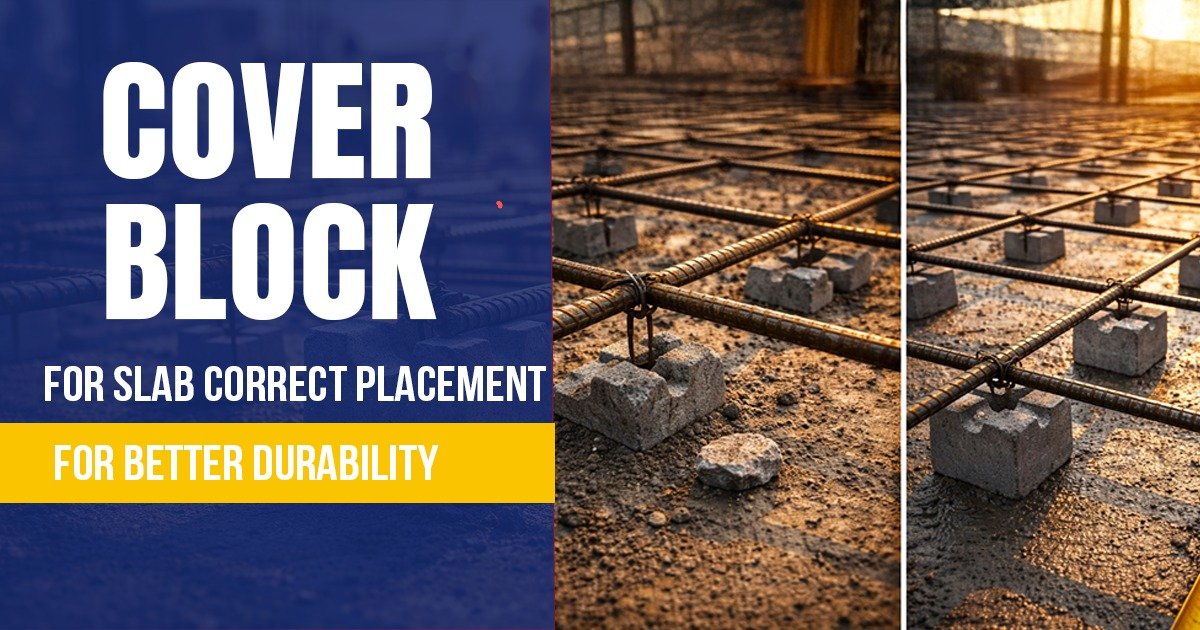
A cover block for slab placed correctly under the reinforcement mesh prevents both problems before they begin.
What "Correct Placement" Actually Looks Like on Site
This is the practical heart of the matter, and it deserves a detailed look.
Step One: Select the Right Cover Block Size
Before a single block is placed, you need to know what thickness is required. This comes from two sources: the structural drawings and IS 456:2000.
For a typical residential roof slab or floor slab:
- Mild exposure (interior protected): 20mm clear cover
- Moderate exposure (external but sheltered): 30mm clear cover
- Severe exposure (roof directly exposed to rain and sun in aggressive environments): 45mm
The cover block size must match the specified clear cover exactly. This means if your structural drawing specifies 25mm cover, you order 25mm cover blocks. Not 20mm because they were available on site. Not 30mm because someone thought more was better. Exactly 25mm, because that is what the engineer calculated.
Step Two: Prepare the Formwork Surface
Cover blocks are placed on the formwork before the reinforcement mesh goes in. The formwork surface should be clean and level. Uneven formwork can cause cover blocks to tilt, which changes the effective cover at that point.
If the formwork has significant deflection at the centre, cover blocks at midspan may be bearing on a lower surface than those at the edges, creating inconsistent cover across the slab. Address formwork issues before placing blocks, not after.
Step Three: Position Cover Blocks at the Right Spacing
This is where many sites underperform, even when they are using cover blocks at all.
A cover block holds the reinforcement at the correct height only at the point where it is placed. Between two cover blocks, the mesh spans freely and can deflect downward under its own weight, under the weight of workers walking on it, and under the pressure of wet concrete during the pour.
Recommended spacing for cover blocks on a slab is one block every 500mm to 800mm in both directions. For heavier reinforcement or larger bar diameters, closer spacing prevents deflection between support points.
Think of it like a suspension bridge scaled down to millimetres. The more support points, the less sag between them. The less sag, the more consistent the cover across the full slab area.
Step Four: Place Blocks Under the Correct Layer
In a typical two-way slab, there are two layers of steel in both the bottom and sometimes the top of the slab. Cover blocks go under the bottom-most layer.
A common mistake is placing cover blocks under the top layer of the bottom mesh. This gives you cover to the wrong bar. The critical bar, the one doing the most structural work in tension, is the bottom-most one, and that is the bar that must sit at the specified cover height.
Step Five: Keep Blocks in Position During the Pour
This sounds obvious but is frequently overlooked during the chaos of a slab pour.
Wet concrete exerts pressure. Vibrators create movement. Workers walk across the mesh to access different areas of the slab. All of these forces can displace cover blocks that were perfectly positioned before the pour began.
Some contractors wire the cover blocks loosely to the reinforcement mesh to prevent displacement. Others use cover blocks with a wider base that provides more stability on the formwork surface. Both approaches work. The key is to verify that blocks have not shifted before and during the early stages of the pour.
The Durability Consequences of Getting This Wrong
Let us be specific about what happens when slab cover block placement is inadequate.
Carbonation reaches the steel faster. Concrete naturally resists carbonation, the process by which atmospheric carbon dioxide reacts with calcium hydroxide in the cement paste to form calcium carbonate, gradually lowering the concrete's pH. When the pH drops below a critical threshold, the passive oxide layer protecting the steel breaks down and corrosion begins. Thinner cover means carbonation reaches the steel sooner.
Chloride attack accelerates in exposed slabs. Roof slabs in coastal cities, terrace slabs that collect rainwater, and parking decks where vehicles bring in road salts are all vulnerable to chloride ingress. Chlorides penetrate concrete at a rate that depends on cover thickness and concrete quality. Insufficient cover shortens the time to corrosion initiation dramatically.
Cracking creates a feedback loop. Once reinforcement corrodes, it expands. This expansion creates internal tensile stresses in the surrounding concrete. Those stresses cause cracking. The cracks expose more steel. More corrosion follows. The cycle accelerates and becomes increasingly difficult and expensive to stop.
Structural capacity drops below design values. A slab designed for a certain load assumes the reinforcement is at a specific effective depth. If the steel is lower than intended because cover was excessive, or higher because cover was insufficient, the slab is not performing as designed. In cases of serious displacement, this can represent a genuine structural safety risk.
Types of Cover Blocks Used in Slab Construction
Not every cover block is identical in form, and understanding the options helps site teams make the right choice.
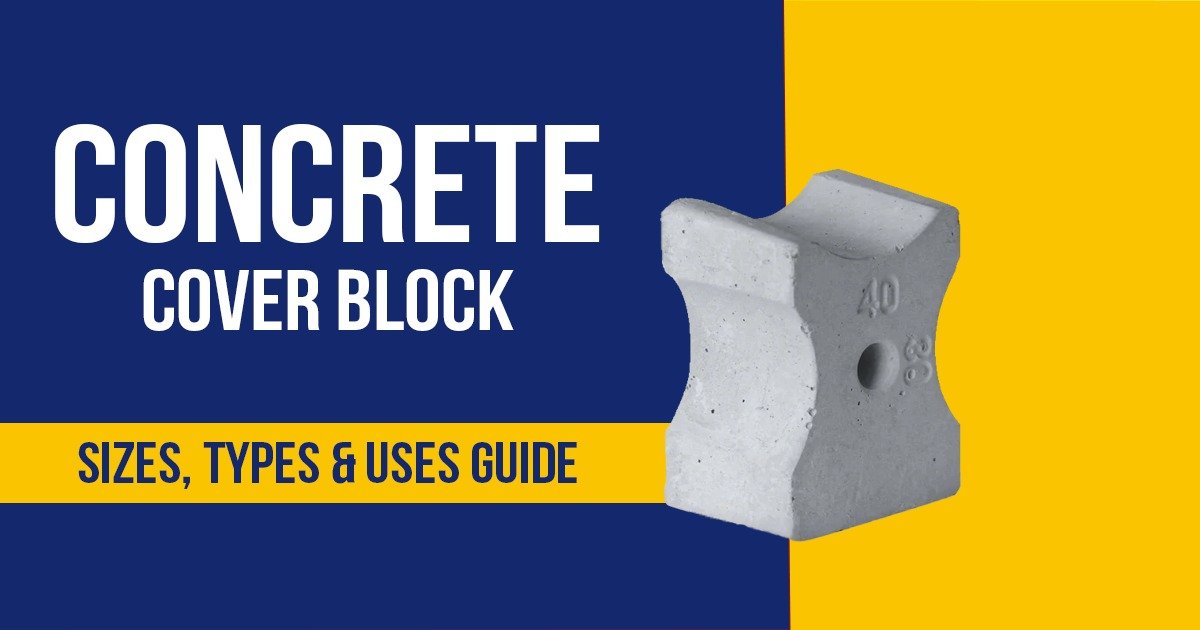
Flat base cement cover blocks are the traditional choice. They sit on the formwork with a flat bottom and bear the weight of the reinforcement mesh above. They work well for standard residential slabs and are widely available.
Concrete cover blocks with higher compressive strength are better suited to industrial slabs, heavy-duty floor plates, and situations where the cover block must bear significant load without cracking.
PVC or plastic chair cover blocks have gained popularity because they clip around the reinforcement bar rather than simply sitting beneath it. This prevents the block from being displaced laterally when concrete flows around it during the pour. They also offer excellent dimensional consistency because they are moulded rather than cast.
Wire-tie cover blocks have embedded wire loops that allow them to be tied directly to the reinforcement, virtually eliminating the risk of displacement. These are particularly useful for slabs where heavy vibration is used.
The right choice depends on the specific slab, the exposure conditions, and the construction process being used.
Real Site Scenario: What Good Placement Looks Like
Picture a five-storey apartment building under construction in a mid-sized Indian city.
The structural engineer has specified 25mm clear cover for the floor slabs, which are classified as moderate exposure due to the building's location and intended use.
The contractor's site supervisor, before the reinforcement is placed, distributes 25mm cement cover blocks across the formwork at approximately 600mm intervals in a grid pattern. The blocks are positioned to align with where the bottom bars of the mesh will sit.
The reinforcement team places the bottom mesh layer. The cover blocks elevate it uniformly to exactly 25mm above the formwork surface. The supervisor walks the slab and checks a sample of points, pressing down on the mesh to confirm that blocks are stable and not rocking.
Where a block has tilted or shifted during mesh placement, it is corrected before the top layer goes in. By the time concrete is ready to pour, the reinforcement is sitting at a consistent, verified 25mm from the soffit of the slab across its entire area.
When a quality auditor checks this slab three days after striking the formwork, the cover meter readings are consistent and within the acceptable range. The slab passes. The contractor moves to the next floor without rework or delay.
That is what correct placement looks like. It is not complicated. But it requires intention, the right materials, and a site team that understands why it matters.
What Makes Goyal Cement Blocking the Right Supply Partner
For the scenario above to play out correctly, the contractor needed one thing before anything else: cover blocks that measured exactly what they were supposed to measure.
This is where Goyal Cement Blocking has built its reputation among contractors and structural engineers across India.
Goyal's cement and concrete cover blocks are manufactured with consistent mix design and precise moulds, so a 25mm block is 25mm when you measure it on site. This sounds like a basic expectation, but in a market where dimensional inconsistency is common, it is a meaningful differentiator.
Beyond dimensions, Goyal cover blocks are produced with the compressive strength required to survive construction loads. A cover block that cracks when the reinforcement mesh is placed on it or when a worker steps across the slab has failed before the concrete even arrives.
For large residential projects, infrastructure work, or commercial construction where thousands of cover blocks are needed across multiple pours, Goyal's production capacity and supply reliability ensure that the right blocks in the right sizes are available when they are needed.
Contractors who have worked with Goyal describe it in simple terms: it is a supplier they do not have to think about, because the product consistently arrives on time, at the right spec, and performs on site. That reliability frees up mental bandwidth for the many other things a site supervisor has to manage.
Common Questions from Site Teams
What if the specified cover seems too large and wastes concrete depth? The cover specified by the structural engineer is based on the design and the exposure condition. Reducing it to save concrete depth compromises both durability and load capacity. Always use the specified cover.
Can we use broken pieces of tiles or bricks as cover in a pinch? No. These have no defined dimension, they can shift easily, and they may not bond well with the surrounding concrete. They are not a substitute for manufactured cover blocks.
How do we handle cover blocks at slab edges where reinforcement is closer to the form edge? Side cover at slab edges is equally important. Use cover blocks or spacers designed for vertical or angled placement at edges, and ensure they match the specified cover for that element.
Do we need cover blocks for the top reinforcement layer in a two-way slab? The top layer needs to be at the correct depth from the top surface. Chairs or high chairs are used to support the top mesh at the right height. This is separate from bottom cover blocks but equally important for structural performance.
The Slab That Lasts Begins With the Block That Holds
A concrete slab does not announce the quality of its construction. It sits quietly above you or beneath you, doing its job without comment.
But that silence is either earned or borrowed. A slab built with correct cover block for slab placement earns its silence through decades of structural integrity. A slab built with inadequate or incorrectly placed cover borrows time, and eventually the debt comes due in cracks, corrosion, and costly repair.
The difference between these two outcomes is often just a matter of using the right cover block, in the right size, placed at the right spacing, by a team that understands why it matters.
Goyal Cement Blocking is here to supply that first part of the equation consistently and reliably. The rest starts with knowledge, and that is exactly what this guide is for.
If you are planning a slab pour and want to ensure your cover block supply meets the specification, reach out to Goyal Cement Blocking for the right product, in the right size, ready when your project needs it.
Frequently Asked Questions
Quick answers to what people usually ask.